


How it works
Rendering by wavelength
Why colors, glass and metal look so natural in Auddomate. Light here is a spectrum, not three numbers.
Light is a spectrum
The light around us isn't red, green and blue. It's a smooth spread of wavelengths, from deep violet to deep red, and every surface reflects each wavelength a little differently. Our eyes and cameras sum all that up into the colors we see.
Most renderers take a shortcut and treat light as just three numbers: red, green and blue. It's quick, and it's usually close, but it can't do everything real light does.
Auddomate's engine, Opal, follows light as a spectrum. Every path of light carries four wavelengths at once, and every color you pick is turned into a smooth spectrum before it touches the scene. You'll see this in the sidebar as Color: Spectral · 4 λ.
What you'll notice
Glass splits light into color. Real glass bends each wavelength by a slightly different amount, which is why a prism makes a rainbow. In Auddomate, crown glass does exactly that: the brightest edges of a glass or a gem fringe into color, all by themselves. It isn't an effect added on top; it simply happens, because each wavelength takes its own path.
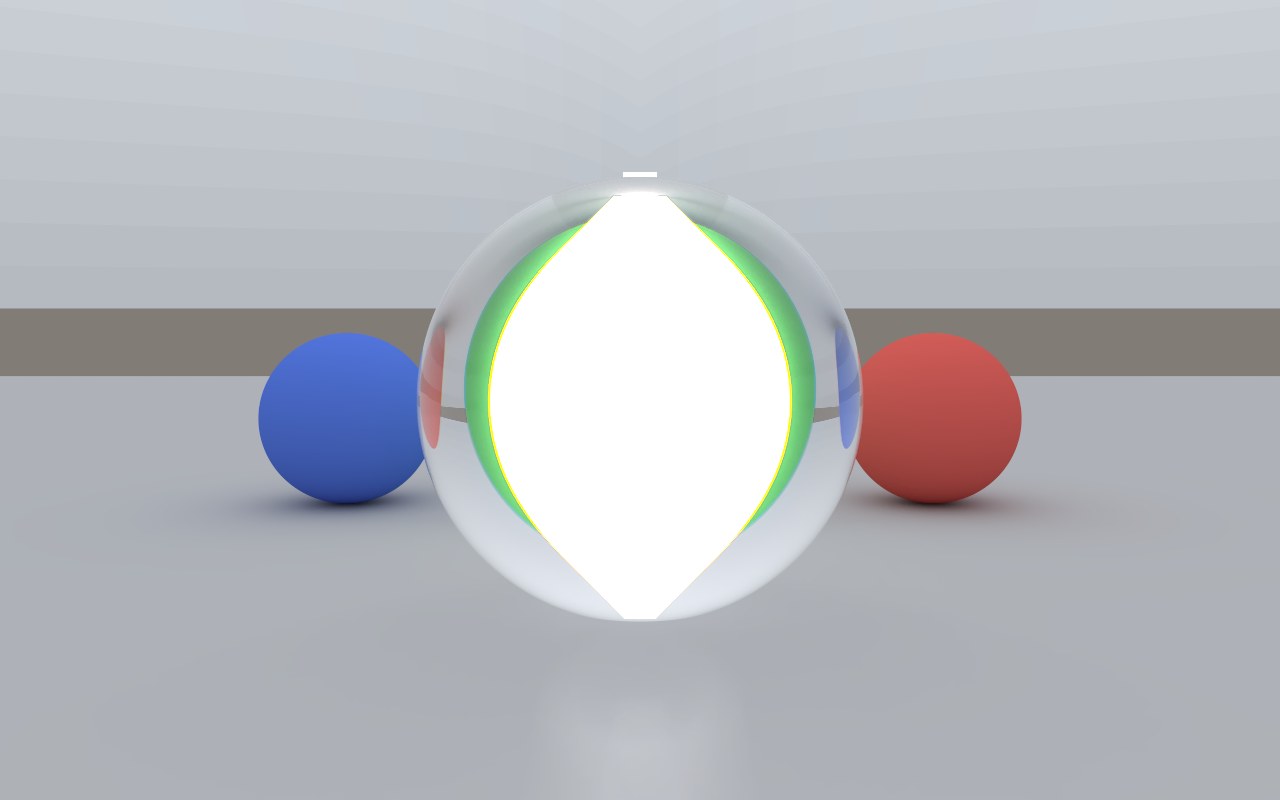
Metals shift color at their edges. Gold, copper and brass reflect each wavelength differently at different angles, so their color warms and shifts towards the edges. Auddomate works this out wavelength by wavelength.
Colors mix truthfully. A red wall bleeds warm light onto a white floor; a green light on a red object makes it dark, as it really would. With three-number rendering, these mixes are often a little off; with spectra they come out right.
Textures stay true. Every pixel of every texture is turned into its own spectrum, so a printed label reacts to colored light just as a real one would.
Does it make rendering slower?
Hardly. Following four wavelengths at once costs a little more than three colors, but Opal is built around it, so the difference is small. In exchange, glass, metal and color are right without any tricks.
Learn more
Rendering by wavelength is one of the reasons Auddomate can be checked against the reference renderer pbrt-v4, which renders spectrally too. See Checks against pbrt-v4.